


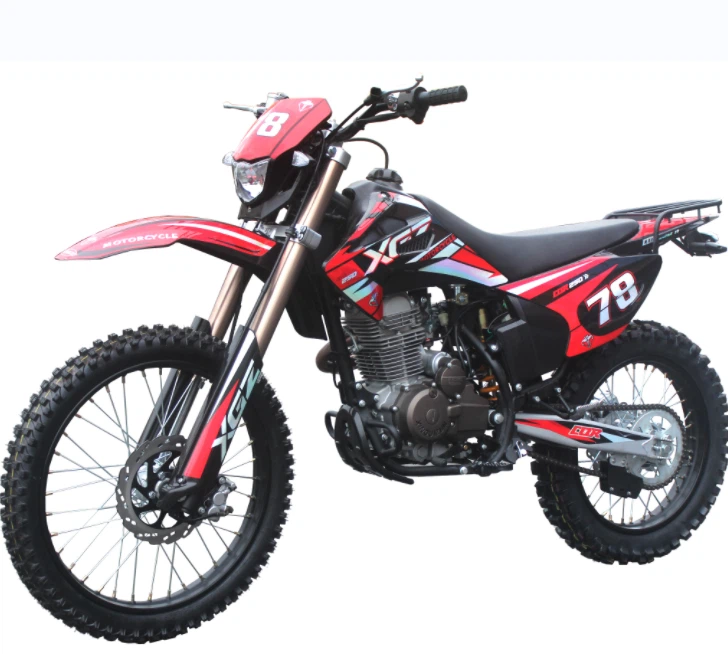
CQR CB300 Off Road Dirt Bike For Adults Racing
Product Introduction
Taking a dirt bike off-road is a fun and exciting activity and can work wonders to improve your riding skills. However, before one begins their off-roading adventure, it is important to pick the dirt bike that is suitable for the terrain you'll be riding on. Motocross tracks usually feature a large number of obstacles in a small space. Things can go wrong very quickly if you make a poor decision as to which dirt bike to bring. The best off-road dirt bike is typically one that has a fuller range of speed as the gearing isn't focused on just 2nd and 3rd gear like motocross. An off-road dirt bike has power through all its gear ratio and is designed for much longer rides in terms of comfortability.
CQR CB300 off-road motorcycle is the latest design of Xinguizun, suitable for all kinds of off-road motorcycle competitions, and can adapt to different terrains such as mud, mountains, steep slopes, etc.
Characteristics of CQR CB300 Off Road Dirt Bike
- Large-Diameter Coil-Spring Fork
- Adjustable footpeg position
- AIR Cooling
- Launch Control Mode
- Adjustable Ergonomics
- Hydraulic Clutch
- Pass Light
- Four Stroke
- Four Valve
- Six Gearshift Balance shaft
Specifications
| CQR-CB300 | |
| Engine: | ZONSEN CB300 ENGIEN Single Cylinder,4-Stroke,Air-cooling, Horizontally Inclined |
| Displacement(ml) | 271.3ml |
| Bore and Stroke(mm×mm) | 75mm×61.4mm |
| Max.Power(kw/r/min) | 16/8500kw/r/min |
| Max.Torque (N.m/r/min) | 22/6500N.m/r/min |
| Compression Ratio | 9.29:1 |
| Lubrication method | Pressure and Splash |
| Clutch method | Manual Wet Multi-Plate |
| Gearshift Method | Constant mesh, Two stage transmission ,5-speed Gearshift |
| Ignition method | CDI |
| Starting method | Electric /Kick |
| Frame | High Strength Steel Tube Frame |
| Muffler | Stainless Steel Muffler |
| Front Shocks | Inverted Fixed Damper Front Shock Absorber |
| Rear Shocks | Mechanical Oil Pressure Adjustable Rear Reducer |
| Front disc brake | Double Piston Pump Hydraulic Front Brake System |
| Rear disc brake | Double Piston Pump Hydraulic Rear Brake System |
| Rim of Wheel | High Strength Aluminum Wheel,Bright Drum Core, Front 1.60 * 21, Rear 2.15 * 18 |
| Tyre Size | Deep Tooth Tire Front 80 / 100-21 Rear 110 / 100-18 |
| Battery | 12V6AH |
| Length * Width *Height | 2070mm* 805mm* 1190mm |
| Ground Clearance | 300mm |
| Seat Height | 880mm |
| Tank Capacity | 7 L |
| Wheel Base | 1400mm |
| Curb Weight | 117kg |
The Different Types of Dirt Bikes
Trail Bike
A trail bike is the most common type designed for dodgeding trees and hopping rocks. Trail bikes are versatile, beginner-friendly and suitable for a variety of recreational riding terrains. These bikes have comfortable seats, user-friendly controls, and moderate power. For adults, they range from 125cc up to 650cc and include both 2 strokes and 4 strokes with engines designed to have smooth power, also making them easier to ride. The seat height is usually a few inches lower than a motocross bike which is better for new riders because it allows you to touch the ground and balance more easily.
Motocross (MX) Bike
Motocross (MX) bikes are just about as popular as trail bikes, but often seen as "top tier" because they have the most powerful engines and the highest technology in suspension which is more firm/stiff to absorb big impacts and landings. MX bikes are built for racing on closed-course competition tracks that have dirt obstacles, such as jumps, berms, and challenging terrain. They are lightweight with high-performance engines (peaky and more difficult to ride), long suspension travel, and aggressive tires.
Enduro Bike
An enduro bike is versatile, designed for a combination of on and off-road riding. They typically have lights and are street-legal, allowing riders to navigate trails, forests, and roads. They cost more than a trail bike, but you get a lot of the technology that motocross bikes have. Enduro bikes have moderate suspension travel and a balance of power and agility. Their engines are tuned for broad power making them easier to ride and less tiring than an MX bike.
Dual-Sport Bike
Dual-sport bikes double as a trail dirt bike and a street legal dirt bike. You can ride on the road, then hop on a trail or dirt road, and still ride comfortably because of the dual sport tires. They typically have less aggressive tires than typical dirt bikes and are equipped with lights, mirrors, and turn signals. Dual-sports offer a compromise between on-road and off-road capabilities with a robust and reliable engine that's not made for high-performance, and a larger fuel tank for longer range riding capability.
Adventure Bike
An adventure bike combines the characteristics of dirt bikes and sportbikes into one versatile machine that's good for both asphalt and dirt surfaces. Designed for long-distance touring and off-road adventures, they are larger and heavier than most dirt bikes, and equipped with features like larger fuel tanks, luggage options, and comfortable seats. Adventure bikes are a rather broad category which can be applied to a wide range of bikes suitable for different types of adventures from touring hundreds of miles across the country or exploring wooded trails.
Hill-Climb Bike
A hill-climb bike is designed specifically for climbing insane uphills. The bike has been modified with an extended swing arm which makes it more difficult for the bike to wheelie and flip that also makes the bike better at finding traction when riding up a hill.
Flat Track Bike
Flat track bikes have one goal in mind, high speed and maximum grip. Flat track bikes are usually raced on a flat surface or an oval shaped track. They are highly customized with lower suspension, slick tires and performance enhancing parts.
Two Stroke Engine VS Four Stroke Engine - Which is Best For Off-Road Bikes?
Cost
Two-stroke engines are generally cheaper than their four-stroke variants, because they require fewer parts and hence fewer materials. Also, since they only use two-piston movements to finish an engine cycle, maintenance on two-stroke engines is not only cheaper but also easier to complete. You'll likely find it easier to clean two-stroke engines as opposed to their four-stroke counterparts which, again, is due to their low complexity.
Weight
Two-stroke engines are both smaller and lighter than four-stroke engines due to pretty much the same reasons as cost. And this is important regardless of where you choose to take your dirt bike. In a hare scramble race, every pound matters as a bike that weighs more is going to slow you down as the race drags on. Being lightweight is one of the reasons why two-stroke bikes find it easier to accelerate and decelerate than four-stroke dirt bikes.
Control
Four-stroke dirt bikes are easier to ride than two-stroke dirt bikes. The faster acceleration on two-stroke dirt bikes can make them harder to handle especially for a beginner. Four-stroke dirt bikes also have what is known as a "wider powerband", which is just another way of saying that they can run more efficiently at a wider range of speeds than their two-stroke counterparts. When off-roading, you will find that you have to shift speeds regularly as the terrain warps and changes. Having a four stroke-bike that can run and brake effectively at different speed levels gives you more time to focus on other aspects of riding which can make for a more comfortable journey overall.
Effect On The Environment
Those who care about the environment need to be aware that two-stroke bikes tend to emit a lot of smoke while running and can also release a lot of burnt oil into the air which can have adverse effects on the surrounding plants. This matters more to off-road bikers as you will likely be riding primarily in green environments. Two-stroke bikes also have higher fuel consumption which can be important to those who are conscious about how much they're spending on their oil.
Choosing the Right Size
The size of the dirt bike is crucial for handling and safety. Here are key considerations:
Engine Capacity:
Measured in cubic centimetres (cc), the engine size determines the bike's power. Beginners might start with 125cc to 250cc, while experienced riders may opt for 450cc or higher.
The engine capacity of a dirt bike plays a pivotal role in defining its overall performance and suitability for different skill levels. For beginners, a bike with a smaller engine, such as 125cc to 250cc, offers a more manageable and forgiving experience. These bikes provide enough power to enjoy off-road riding while keeping the speed and acceleration controllable, which is crucial for building confidence and skill. In contrast, larger engines, like those 450cc and above, are designed for experienced riders who can handle greater power and speed.
These high-capacity engines deliver intense acceleration and top speeds, making them suitable for competitive racing and challenging terrains. However, with greater power comes the need for better control and advanced riding skills, making these bikes less suitable for novice riders.
Bike Size:
Ensure the bike fits your height and weight. You should be able to touch the ground with both feet when seated.
The importance of a properly sized bike extends beyond simple comfort; it's crucial for safety and control while riding. A bike that is too large or too small for a rider can lead to handling difficulties, increased fatigue, and a higher risk of accidents.
The right fit allows for more precise control over the bike, particularly in challenging off-road conditions where manoeuvrability and responsiveness are key. Additionally, being able to plant both feet firmly on the ground when stationary provides stability and confidence, especially in situations where quick stops or balance adjustments are necessary. For riders who are particularly tall or short, some bikes can be adjusted or modified with different seat heights and handlebar positions to ensure a more custom fit.
What Kind of Maintenance Does a Dirt Bike Need?
Washing
- Manually remove large chunks of dried mud. Use a Mud Axe to dig out mud and dirt stuck in crevices.
- Avoid sticking the pressure washer's nozzle on the bike's airbox (without an airbox wash cover), electronic parts, wheel bearings, countershaft, and chain. This could lead to corrosion which will destroy the inner parts of your bike.
- Make sure your pressure washer is under 3,000 PSI.
- Maintain a 2 to 3 feet distance between the nozzle and the dirt bike. It can prevent any physical damage caused by the pressure.
- Do not use abrasive cleaners, or else you will damage the plastic and other softer parts of your dirt bike.
- Dry off your dirt bike after washing using a dry towel to prevent extended contact with water. You can also use an air compressor or a leaf blower, especially on nooks and crevices.
Air Filter Cleaning
If you're a casual rider, you should clean your air filter before it gets dirty. However, for riders and those who are riding tracks with heavy dust and muck, air filters should be cleaned every after use. Simply remove dirt and debris using a specific air filter cleaning agent. On average, the air filter should be replaced every 2 to 4 rides. But this could vary depending on the dirt bike model and how hard you have been riding your bike and the type of terrain you like to ride on.
Routine Checkup for Brake Pads
Brake pads are not meant to last forever. So naturally, they will be worn out after a certain amount ride time. The front brake is responsible for 70% of the dirt bike braking system, which means that it should be inspected regularly. If damage has been spotted on your brake pad, it has to be fixed as soon as possible. On the other hand, you can detect if the brake pad is exhausted if the friction material is visibly worn out. If you choose not to change it, you might be risking mechanical failure which can compromise your safety.
Engine and Fork Oil Change
Engine oil should be changed every 3 hours of dirt bike riding. If your track or terrain is filled with dust and grime, change your engine oil sooner. Another oil driven component that needs your attention is your forks and shock. If your dirt bike has an oil-driven front fork, don't forget to keep those forks clean and have the oil changed if necessary. Just like the engine oil, the oil in your forks can get dirty and inhibit the function of your suspension.
Chain Tension Check and Lubrication
There is a probability that the chain becomes loose. This incorrect chain tension can lead to several damages involving your sprocket. To tighten your dirt bike chain, all you need is a large crescent wrench, a bike stand, grunge brush, and chain lube. Start by loosening the nut on the axel, followed by the locknuts. Then turn the tension bolt out until it is properly tightened. Repeat the process on the other side. Aside from tightening the chain tension, don't forget to clean and lubricate the chain. Place the dirt bike on the stand and grab your degreaser and brush. Spray the chain with the degreaser and use the brush to spread the solution.
Hot Tags: CQR CB300 Off Road Dirt Bike For Adults Racing, China CQR CB300 Off Road Dirt Bike For Adults Racing manufacturers, suppliers, factory, Hill Climb Racing Motorcycle, 250cc Motorcycle, Off Road Touring Motorcycle, Trail Motorbike, Pro Racer Motorcycles, Forest Road Motocross
You Might Also Like


Send Inquiry